Nothing Personnel
PIPs, Personnel Files, and Using Your Employer's Best Documents Against Them
August 3, 2026
6 minute read
Almost everyone thinks they’re a good driver, but nobody is perfect. We all make mistakes—drifting a few miles over the limit, forgetting a turn signal, cutting somebody off. Catch a cop in a sour mood while you’re making one of them, and the consequences can be serious.
Think of your personnel file the same way.
If your boss is patient, he doesn’t have to fabricate a reason to fire you. He just has to wait for you to make a mistake, log that mistake in your personnel file, and then use that mistake to wipe out years of good work.
I don’t mean to make it sound so simple—laying that foundation takes skill. Large law firms bill millions of dollars a year in “advice and counsel” to employers who want to discriminate and retaliate within the confines of the law. A termination that survives a courtroom doesn’t happen by accident. It gets assembled.
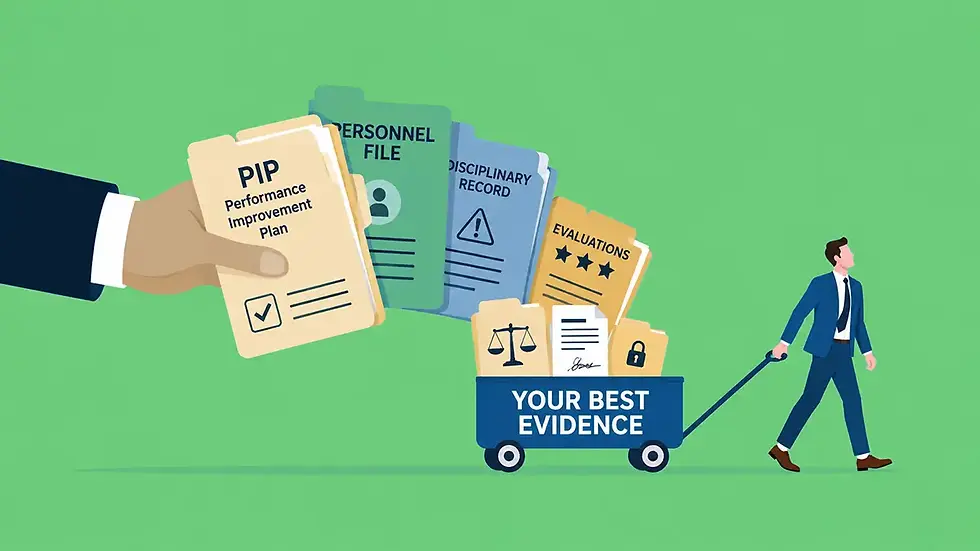
But that process creates a paper trail, and your employer runs a serious risk when he picks and chooses what documents go into your file. Here is what the process looks like from the inside, and why the paperwork built to justify firing you is so often the paperwork that proves you have a case.
1. The Blindside Review
Four years of “meets expectations.” Then a written warning about something nobody mentioned last quarter.
The rule on the management side is close to absolute: never take any adverse action off a clean record. Document, document, document. Get it written, get it dated, get the employee to acknowledge it. A firing with no paper behind it gives an employee’s lawyer an open field to craft a narrative, so the paper comes first and the firing comes later.
The trouble is that most employers aren’t disciplined enough to do it well. Documentation is a habit, and a company with poor HR hygiene will scramble to document at the eleventh hour like a student cramming for a final exam. So instead of a record that thins out gradually over years, you get a file that was unremarkable in March and damning by June. Things that were non-issues start getting escalated. Feedback that used to happen in a hallway now arrives by email, with somebody copied.
A decline that was actually happening would have left traces the whole way along. A decline that has to be manufactured tends to appear all at once. In a lot of cases, when the criticism arrives is more important than what that criticism is.
Criticism that surfaces the week after you raised a concern, requested an accommodation, reported something, or came back from leave is not the same as criticism that accumulated over a year. Employers consistently underestimate how much work that sequence does. If your file got busy right after you spoke up, they have to have a very good explanation as to why.
2. The Uneven Hand
The next instruction is consistency. Whatever standard you’re enforcing, enforce it against everybody. Write up the whole team or write up none of it, because a rule that exists for exactly one person reads as a rule invented for that person.
It’s also the hardest instruction for an employer to follow, because the entire premise of the exercise is that one particular employee is the problem. Again, lazy recordkeeping results in a standard getting applied selectively, and everyone else goes on making the same mistakes in peace.
Documentation helps an employer when the errors are identified consistently across employees. That’s not an easy thing to do. As a Plaintiff, this is one of the few situations in life where whataboutism is an effective argument. Sure, you came to work late, but what about all the other employees who came in late and were never punished?
The question is almost never whether you made the mistake. It’s whether the colleague who made the same mistake got a memo about it. Selective documentation of one employee, in a department where identical conduct goes unpapered for everyone else, isn’t evidence about your performance. It’s evidence about the decision-maker.
3. The Performance Improvement Plan
By the time a PIP shows up, the file is mostly built. This is the closing move.
A PIP gets presented as an opportunity, and occasionally that’s what it is. But its real function is to convert an accumulating record into a deadline. In a single document, your employer sets out the standard you’re supposed to meet, the ways you’ve failed to meet it, and the date by which you have to fix it. Then he asks you to sign, acknowledging all of it.
Nothing else in the management toolkit produces that much usable paper that fast. And nothing else hands a supervisor the thing he actually wants, which is a date—a day on the calendar when he believes he can finally fire you without consequence. More often than you would think, the termination paperwork is drafted before the plan is delivered.
The PIP is a crucial document, but also one that has to be delicately crafted. Make the goals concrete. Make them genuinely achievable. Offer real support, and document the support you offered. None of that is generosity. A plan that looks like it’s setting an employee up to fail won’t curry any favor with a jury.
If done correctly, the PIP establishes the employer as the good guy and the employee as either unwilling or unable to meet the minimum expectations of the job. But that’s a big if.
A PIP is a one-sided document. Anything that cuts against the argument—that you are a bad employee for reasons having nothing to do with a protected characteristic—simply doesn’t go in. So read it for what is absent. What context got left out? Are the metrics unreasonable? Are they measurable at all? Does the “plan” put the entire burden on you while giving you no access to the resources you would need to meet it?
If so, the document stops working the way it was designed to. A plan with no support, no measurable target, and no acknowledgment of the circumstances isn’t evidence that you failed, it’s evidence that somebody wanted you to fail.
A PIP constrains you, but it also commits your employer. It puts in writing the standard that applied, the metrics that counted, the support he agreed to provide, and the date by which you were to be judged. From the moment he hands it over, he is bound to that story. Fire you before the deadline, or for a reason that appears nowhere in the plan, or after the help described in it never materialized, or even after you meet the PIP’s goals, then the PIP ceases to be about the actual reason you were fired.
Keep in mind that receiving a PIP is not an adverse employment action in and of itself, and plenty of employees come out the other side having genuinely improved. But more often than not, the PIP is only planning for your failure, not your success.
4. The Trap in the Method
Which brings us to the problem that doesn’t occur to most employers until it is far too late.
Go back to the first step. A decline is a comparison, and a comparison needs both halves. To show that your performance fell off, the file has to establish what it fell off from. That means the good years have to be in there too—the strong reviews, the raises, the bonus justifications, the commendations, the memo announcing your promotion.
An employer who quietly drops the favorable history doesn’t get a cleaner case. He gets a file that begins in the middle, and a file that begins in the middle is its own kind of evidence.
So the method requires a complete record, and the record is required by law. Under M.G.L. c. 149, § 52C, an employer with twenty or more employees has to preserve the complete personnel record—without deletions or expungement—from your date of hire through three years after you leave, and has to preserve anything relevant once a claim is pending. He is also supposed to notify you within ten days of putting anything negative in the file (an obligation that gets ignored constantly).
There is also a second file almost nobody thinks about. Under M.G.L. c. 151, § 15, your employer has to keep a true and accurate record of what you were paid each pay period and the hours you worked each day and each week, and keep it for three years.
Numbers don’t lie. A personnel file describing you as disengaged reads differently next to timekeeping showing sixty-hour weeks. A file built on missed numbers reads differently next to the commission records showing what you actually produced.
That’s the last part of the trap. Your employer needs a thorough file to justify what he is about to do, and thorough runs in both directions. Every document establishing the decline sits in the same folder as the documents establishing everything that came before it. He doesn’t get to produce one without the other.
Going on Offense
You have a right to your record. Under § 52C you can demand a copy in writing and your employer has five business days to produce it. You can only request your file twice every calendar year, but take a step back before you do so. Asking is not a neutral act. A personnel file request from an employee who hasn’t been fired yet tells your employer you are contemplating a claim, and it invites the two things you would least like to see: a sudden flurry of activity in the file, and an accelerated decision about your employment.
There’s no reason to rush. The law requires your employer to preserve the record, and that obligation only hardens once a claim is pending. Spending one of your two requests at the wrong moment, before anyone has looked at what you actually have, is a bad trade.
In practice, the file is usually requested by counsel, and requested as part of building something. The first real step in most employment matters is a demand letter—a letter setting out the facts, the legal theories, and what resolution would look like, sent before anything is filed. The personnel file is ordinarily the foundation of that letter. It shows what your employer has documented, what he hasn’t, what he intends to argue, and where the story stops holding together. Read next to the payroll records, it regularly turns up claims the employee never knew he had.
Timed well, that request arrives when your employer is already on notice and the file is already frozen. Timed badly, it just tells him to get organized.
Nothing I’ve written above means that a PIP is a firing, or that a bad review is a lawsuit. Plenty of files are exactly what they appear to be, and plenty of employers are simply managing.
When the day comes, your employer will tell you it’s nothing personal. He may even be telling the truth. It was a process, run by people who were paid to run it correctly—and a process that carefully left paper everywhere.
A good employment attorney can help you read between the lines.
Sebastian P. Clarkin is an employment attorney representing employees and executives across Massachusetts. This post is for informational purposes only and does not constitute legal advice. Reading this post does not create an attorney-client relationship. If you believe you are being managed out or your termination was unlawful, contact the firm directly.